
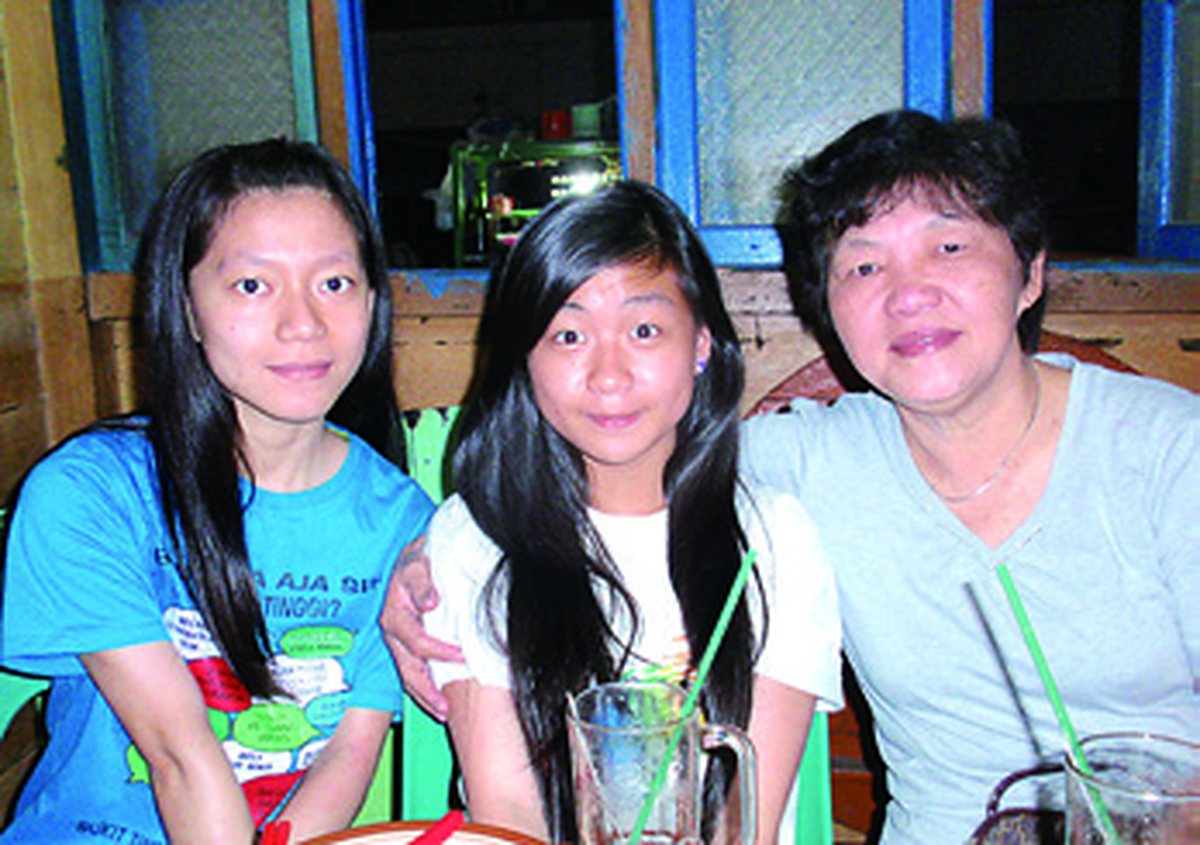
The passing of Ps Lasnini Ang on 4 January did not really surprise me. Rather, I was amazed that this humble maid of the Lord could remain so quietly faithful and focused until the final week, when we spoke by phone.
On 30 December, Ps Lasnini mentioned her daughter Debora’s wedding plan for 16 January. She told me she now had to sit down while preaching because her legs were feeble. She passed away five days later, on 4 January, in Medan, at the age of 66.
Recently, during a family devotion, we read through Ecclesiastes. Its third chapter speaks of a Creator God who has set “a season, a time for every purpose under heaven” (verse 1), including “a time to die” (verse 2). In a global pandemic, people everywhere are dying, mourning and suffering.
God’s plans for His children are always wise, just and good, and Ecclesiastes encourages us to seize every opportunity for good work. We should always be doing something, because none is sent to this world to be idle. It is our business to live according to God’s plan in this life, and for that we should seek to redeem the time, because life is short and uncertain.
“We should always be doing something, because none is sent to this world to be idle.”
Chan Tham Seng
Here I wish to share with you the life of our Indonesian mission partner, Ps Lasnini, as one worthily spent according to God’s plan.
A humble maid of the Lord
I first met Ps Lasnini in May 2006, on our mission trip to Bagan Siapiapi in Riau province, Sumatra. For more than a dozen years after that, we worked together cordially in this poor coastal region on the other side of the Straits of Malacca. Until the 1930s, the seas around Bagan Siapiapi, Panipahan and Pulau Halang were the world’s second largest fishing ground, before siltation, pollution and overfishing destroyed it altogether.
For all the years we knew her, Ps Lasnini remained a humble maid of the Lord. She was not the charismatic type in preaching or in pastoring the Bagan Wesley Methodist Church. At first she travelled three hours to the Dumai pier to fetch us to the Bagan parsonage. There she made sure we were comfortably settled in a clean church hostel kept for guests. In Bagan she would cook for us herself at the parsonage, or take us for roadside food sold by Hokkien-speaking locals. When it came to ministry, she took us to church members’ homes for cell meetings, or to schools for student ministry.
All went smoothly until August 2017, when Ps Lasnini told me of her medical condition. Back in 2001, aged 45, she was in Malacca with other Indonesian pastors, where they decided to have medical check-ups. To her surprise, the tests revealed a serious blood condition that needed immediate treatment. A hospital in Jakarta confirmed it, and she arranged to be admitted to a hospital in Zhangzhou, China. By the start of a three-month therapy there, the winter had become so unbearable that she returned to Indonesia despite her condition (“my body swelled to twice its normal size”). God preserved her life, and since then she had made regular trips to Singapore for treatment (“I am living on borrowed time and continue to move about”).
After August 2017 she did not talk about her condition again until the final week of her life. In December 2020 we were still exchanging Christmas greetings on WhatsApp. We had kept in touch since our last Bagan visit in May 2018 and were planning more trips. Three times we postponed them: political tension, the Covid-19 pandemic and other reasons.
Her daughters
For the final chapter of her life, Ps Lasnini must have set her priorities. I believe they included making sure her daughters were well established, and our mission partnership fruitful.
Debora and her younger sister, Allen, were daughters of Ps Lasnini’s siblings in Jakarta. Through unforeseen circumstances, Ps Lasnini took on the bringing up of her two infant nieces in the parsonage (“sometimes with the help of Bagan church board members”). Being single, she gave part of her pastoral time to caring for her two foster daughters with a mother’s love.
Debora, now 29, has completed postgraduate study at a university in China. Allen, 23, an undergraduate in Taiwan, missed the last farewell with her mother because of Covid-19 travel restrictions. Meanwhile Debora and her fiancé Yacobus (“an Aceh-born Chinese who grew up in the Bagan church and now works in Jakarta”) were declared husband and wife in a simple ceremony in a Medan hospital. What a great joy for Ps Lasnini to take this memory into eternity!
The life of Ps Lasnini shows the Creator God who guides the lives of His children and blesses the faithful ones. God added 20 years to her life after this rare disease was found. God also brought Debora’s wedding forward, so that Ps Lasnini could witness it from her hospital bed a few hours before she was called home.
Four mission schools
Ps Lasnini, I reckon, must have been pleased with our working relationship, for she gave us a free hand to minister in the four mission schools in her parish care:
The Pulau Halang School (400 students) is still the poorest: its students drink rainwater, and there is no concrete walkway round the island (note 1). The Panipahan School (800 students), a timber and zinc building on the muddy seabed, still shakes in strong wind and rain (note 2). The Sungai Bakau School (a few primary classes), threatened by coastal erosion, has just moved further inland. The Bagan Siapiapi School (the biggest, from preschool to senior high school), in a tattered old building, continues to shine for Jesus in a town “with a thousand kelenteng (temples)”, under an orthodox Islamic administration.
The four schools have a good mix of Chinese, Batak, Javanese, Nias and Malay students. Despite the Islamic majority, the Indonesian government allows mission schools to teach the Bible and say prayers in class. We always prayed for a long-lasting partnership with Ps Lasnini in reaching Indonesian students with the gospel.
Because the schools are so different, we used different methods. We held gospel and fun gatherings for primary pupils. We spoke to Christian fellowships and student assemblies. We showed gospel films to students and local people. For closer contact, we preferred teaching Chinese and English in small classes (usually under 30 students), which always ended with some students making a personal commitment to receive Jesus as Lord and Saviour.
Over the years, many of our church members took part in the Indonesian ministry by going on mission trips, giving towards needy students and praying in the background. By my own records, about 440 decisions for Jesus were made, and our members gave some RM43,870 in education aid to needy students. That does not include our support for two Batak students from the Pulau Halang School to study theology in Jakarta.
One of them, William Fernando Simatupang, a fisherman’s son, completed his seminary training (2012–2016) and now serves as a pastor in western Sumatra. The other, Yohannes Andri, the son of a Pulau Halang School teacher, has just completed his first year at the same Bible school.
We are grateful to God for using us to bless our Indonesian brothers and sisters. Our thanks also go to the late Ps Lasnini for making this possible by her faithful and obedient life. God willing, our church will continue to minister in this part of Riau province with Ps Lasnini’s successor.
Note 1: Ps Lasnini herself was posted to serve in Pulau Halang (1979–1983) after her Bible school training in Medan (1975–1979). The fishing island then had only rickety wooden platforms as walkways.
Note 2: Ps Lasnini played an active part in founding the Panipahan School. She helped buy a piece of seabed in 1995 to build the school, which opened in 1997.
Chan Tham Seng
First published in Voice of Hope, Jan–Jun 2021. Read the issue (PDF)